
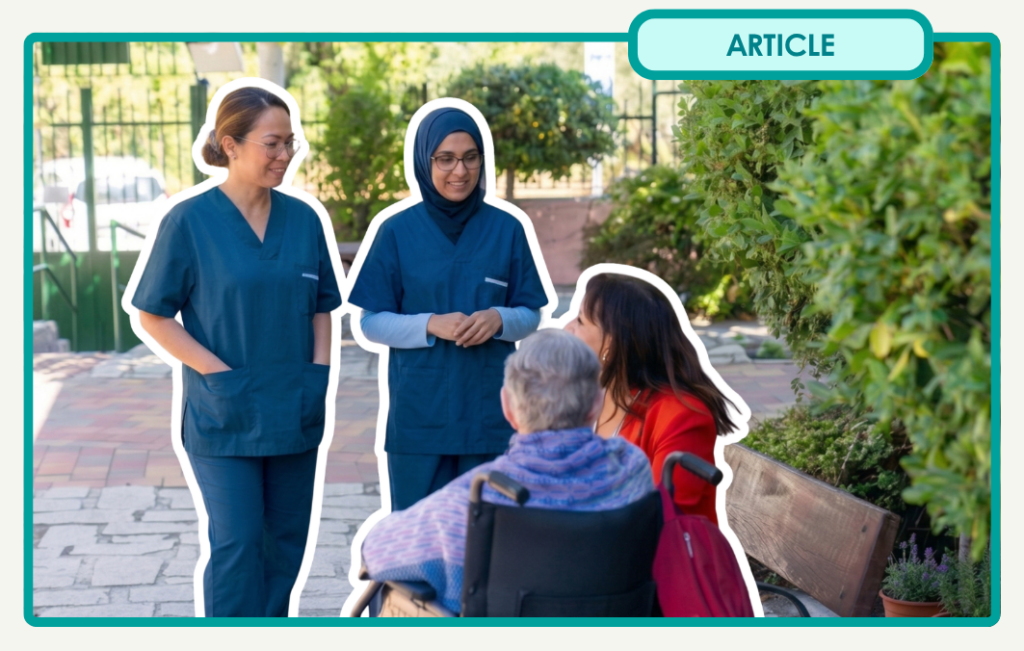
Most care teams have had this experience.
The shift is busy. Someone has called in sick. A family member needs more time than expected. A client is unsettled. A resident needs support right when everyone is already stretched.
Nothing dramatic has happened, but the whole team can feel the pressure building.
And in those moments, the attitude people bring to work matters.
Not in a cheesy “just be positive” way. I don’t think that helps anyone. Care work is too real for that. People are tired, the work is emotional, and some days are genuinely hard.
But there is a big difference between a team member who thinks:
“What can I do to help right now?”
and one who thinks:
“Well, that’s not my problem.”
That difference changes the feel of the whole shift.
It changes how people speak to each other. It changes whether things get followed up. It changes whether small issues are noticed early or left for the next person. And ultimately, it can change the experience of the person receiving care.
That is why we talk about attitudes in Between the Flags.
Not because we want everyone to smile all day.
Because attitudes show up in behaviour.
What does “between the flags” mean?
Most Australians understand the idea of swimming between the flags.
The lifesavers put the flags where it is safest to swim. The ocean is still the ocean. There are still waves. People still need to pay attention. But the flags give everyone a clear, shared place to return to.
Teams need the same thing.
They need to know what behaviours are “between the flags” — the behaviours that help the team stay safe, respectful and accountable.
In a care team, that might look like:
Taking responsibility for your part of the shift.
Letting someone know early when something has changed.
Asking for help before you get overwhelmed.
Following through on what you said you would do.
Speaking to people with respect, even when you are frustrated.
Noticing what needs to be done, rather than walking past it.
It sounds simple, but it is often where teams come unstuck.
Most team problems do not start with one huge incident. They start with small behaviours that become normal.
Someone does not pass on a message.
Someone leaves a task half-done.
Someone speaks sharply at handover.
Someone says, “I thought someone else was doing it.”
Someone assumes, avoids, blames or withdraws.
On their own, these things may not look like much. But repeated over time, they change the team.
“Beyond the flags” is where the excuses live
Every workplace has its own version of beyond the flags.
In care teams, it can sound like:
“No one told me.”
“That’s not my job.”
“I already said something.”
“They never listen anyway.”
“I was too busy.”
“Someone else should have done it.”
Now, sometimes those statements are true. Sometimes people really are under pressure. Sometimes communication has genuinely broken down. Sometimes the system has made the work harder than it needs to be.
But even when there is truth in the excuse, the team still has to ask:
“What do we do now?”
That is the difference.
Beyond the flags attitudes get stuck in the reason why something did not happen.
Between the flags moves towards responsibility.
It says:
“What is my part?”
“What needs to happen next?”
“Who needs to know?”
“How do we stop this from becoming a bigger issue?”
This is not about blaming staff. In fact, it is the opposite.
Blame usually makes people hide, defend or shut down. Accountability gives people a way back.
Care teams need shared language
One of the reasons I like the Between the Flags model is that it gives teams a way to talk about behaviour without turning everything into a personal attack.
Instead of saying, “You have a bad attitude,” a leader can say:
“That behaviour is sitting beyond the flags. Let’s bring it back.”
That is a very different conversation.
It still names the issue, but it gives the person a way to correct course.
And team members can use the language too. They can start to notice their own behaviour.
“I think I’m drifting beyond the flags here.”
“I need to reset.”
“I’m frustrated, but I still need to deal with this properly.”
That kind of shared language is powerful, especially in teams where people are doing emotionally demanding work.
The real question
A strong care team is not a perfect team.
It is a team that notices when it is drifting.
It is a team that can pause, reset and come back to the behaviours that matter.
So the question for leaders is not:
“How do we make everyone positive all the time?”
The better question is:
“Have we clearly named the behaviours we expect from each other, especially when the shift is hard?”
Because that is when the flags matter most.
Not on the easy days.
On the days when everyone is tired, stretched, and one small thing could tip the team into blame.
That is when the attitude people bring to work makes all the difference.
Author: Adrian Pattra-McLean is a management consultant and founder of Farran Street Education with a Master of Education (Ed. Psychology). He is currently facilitating the "Between The Flags" workshop. 



This is very true. Attitude is so important. What i would like to see in these articles, especially for aged care, is the mention of interaction between care staff & support services staff like catering, cleaning etc. There is often a mindset in my organisation, that one role is more important the other & friction occurs.
Yes, respect and mutual understanding between teams is so important.